Showing posts with label health. Show all posts
Monday, March 13, 2017
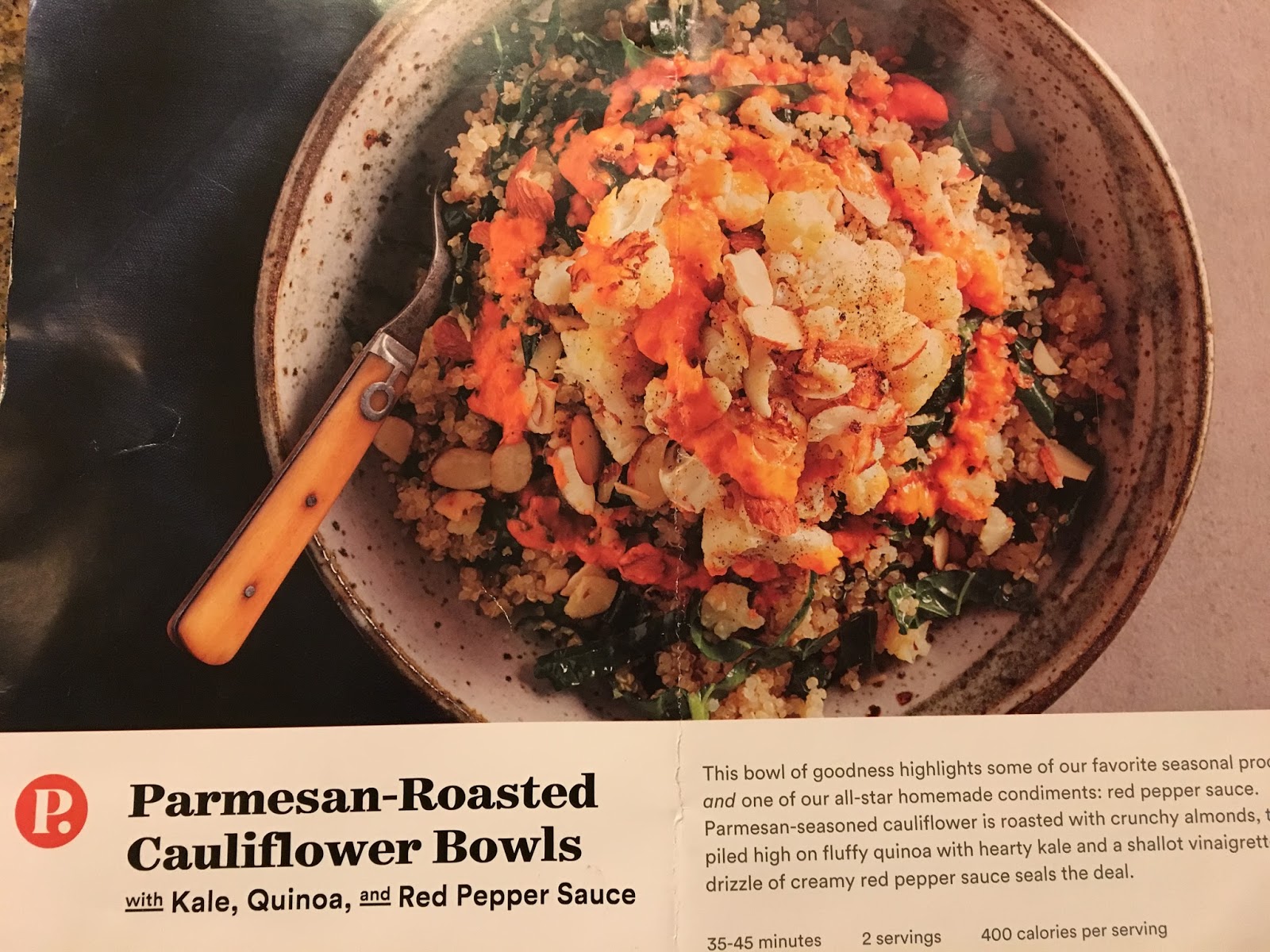
Parmesan Roasted Cauliflower Bowls
(2 servings) from Plated
Ingredients:
2/3 cup quinoa
12 oz cauliflower
1 Tbs grated Parmesan cheese
3 Tbs sliced almonds
6 oz dinosaur kale
1 shallot 1 clove garlic
1 1/2 tbs apple cider vinegar
1 Tbs dijon mustard
1 Tbs honey
1/4 cup roasted red peppers
1 Tbs balsamic vinegar
1/4 cup plus 3 Tbs olive oil
Preheat oven to 425. In small pot combine quinoa, 1 1/3 cups water and 1/4 tsp salt. Bring to boil, cover, reduct heat to medium low, simmer until water is evaporated and quinoa is tender, about 15 minutes. Remove pot from heat, set aside still covered.
While quinoa cooks, cute cauliflower into 1/2 inch florets, discarding tough stem and leaves. On a baking sheet, toss cauliflower with Parmesan and 1 Tbs olive oil. Season with salt and pepper as desired. Roast in oven until lightly browned, about 15 minutes. Remove from oven, sprinkle over almonds and continue roasting until almonds are golden and cauliflower is tender, 5 more minutes. Set aside.
While cauliflower roasts, rinse kale, trim and discard stems, and thinly slice leaves crosswise. Mince shallot to yield about 1 1/2 TBs. Mince garlic. In large bowl, whisk together apple cider vinegar, dijon mustard, 1/2 TBs honey, and minced shallot. Season with salt and pepper as desired. Whisking continuously, slowly add 1/4 cup olive oil until fully combined. Add kale to bowl and, using your hands, massage until fully coated and beginning to soften, 1-2 minutes.
In a blender, combine roasted red peppers, balsamic vinegar, garlic, remaining honey, and 2 Tbs olive oil. Pulse until mixture is smooth and combined (immersion blender works well too). Alternatively chop roasted red peppers and whisk with remaining ingredients in a medium bowl until mixture comes together. Season with salt and pepper as desired.
Plate: Add quinoa to bowl with kale and toss to combine. Divide kale and quinoa between serving bowls and top with cauliflower and almonds. Drizzle red pepper sauce.
Wednesday, August 7, 2013
Tumeric Tea
How To: Making Turmeric Tea
Published: 8/7/2013
Published: 8/7/2013

Turmeric (Curcuma longa) is a culinary spice that spans cultures - it is a major ingredient in Indian curries, and is what makes American mustard yellow. Evidence is accumulating that this brightly colored relative of ginger is a promising disease-preventive agent as well, outperforming many pharmaceuticals in its effects against chronic, debilitating diseases such as Alzheimer's, arthritis, cancer and even possibly depression - all with virtually no adverse side effects.
To get more turmeric into your diet, consider drinking it in tea form. The recipe is simple, and you can experiment with the ingredients and flavorings until you find a combination that suits your taste.
Turmeric Tea
- Bring four cups of water to a boil.
- Add one teaspoon of ground turmeric and reduce to a simmer for 10 minutes.
- Strain the tea through a fine sieve into a cup, add honey and/or lemon to taste.
Some people like to add a teaspoon of ginger along with the turmeric. While ground versions are more convenient, it's worthwhile to experiment with freshly grated turmeric for a more vibrant flavor. These distinctive, deep-orange roots are increasingly available in American grocery and natural food stores. Enjoy!
Sunday, September 9, 2012
Almond milk
Almond milk is a great alternative to regular cow's milk. It tastes great in drinks like my Chocolate Banana Peanut Butter Smoothie.
And it's lower in calories. Here's a comparison for 1 cup:
Whole milk 150
2% 130
1% 110
skim 80
plain soymilk 100
plain almond milk 40
If you want the lowest calories, be sure to get plain unsweetened. I can find Blue Diamond, SO Delicious and Almond Dream brands in my local stores.
Last week I found a new higher protein version by So Delicious (in the picture above). It has 5 grams of protein vs. 1 gram in the regular version - and no extra calories!
Wednesday, August 22, 2012
Lard?
We haven't posted many recipes lately - maybe because our summers have been so busy! We've had little time for experimenting in the kitchen. But school started or is starting soon and we will be back into a routine of family dinners, fun gatherings and hopefully, some new recipes.
Even when I'm too busy to cook I always scan my Dr Weil emails. I was surprised, maybe a little shocked, by todays email rethinking the health benefits of lard - really???
As I read it through, I realized that we need to be careful with our assumptions about health. Ideas shift with time. Science is not exact - it's a bundle of theories that rely on imperfect evidence - and interpretations of that evidence sometimes change.
There's been a clear shifting of ideas concerning health during my lifetime.
As we were raising our children in the 70s and 80s, sugar was the enemy. I remember being counseled to add a little more butter or oil to a baking recipe in order to decrease the sugar.
As our children were entering high school, our assumptions turned upside down and there was a new enemy - fat. We could eat about anything we wanted as long as it was labeled "fat free." Our diets were full of refined carbs and sugar - but we weren't eating any of that bad fat!
The came the Atkins revolution. Fat is OK and Protein is king. Carbs became the big enemy. We could eat bacon, eggs, and steak for breakfast! I will never forget sitting at breakfast in the South American country of Guyana. The buffet tables were dripping with gorgeous and delicious local fruits. But this couple filled their plates with bacon, eggs, meats and not one bite of fruit! I looked from my fresh colorful plate to theirs dripping in grease and just couldn't understand why someone would choose to eat like that. It didn't feel right.
We are still living under the "protein is king" assumption. Will it last? It seems like our ideas change about every 10 years - so we need to be wise and careful.
This is a long introduction to Dr Weil's article on lard - that might now be a healthy part of our diets!?!

In the minds of many people, lard is the most unhealthy food imaginable. The conventional wisdom of the last 40 years has been that saturated fats in our diets - that is, fats such as lard that are solid at room temperature - are a principal cause of high cholesterol and rising rates of heart disease.
However, those conclusions now seem to be based on rather shaky science. A more recent scientific analysis of 21 studies determined that there is no significant evidence thatdietary saturated fat is associated with an increased risk of coronary artery disease. Instead, the principal culprit in the obesity epidemic, and a major contributor to heart disease, appears to be overconsumption of sugars and carbohydrate-intensive foods.
Nutritionally speaking, lard has more than twice the monounsaturated fat of butter. It is also low in omega-6 fatty acids, known to promote inflammation. According to lard enthusiasts, free-range pigs that eat greens, not grains, have higher levels of omega-3 fatty acids.
Lard has always been prized as a cooking fat because it has a higher smoking point than other fats. For that reason, foods fried in lard absorb less grease. It also has the reputation of producing ultra-flaky pastry crust. For all of these reasons, lard has been making a comeback in high-end restaurants.
Avoid hydrogenated lard from supermarkets. The best lard is considered to be minimally processed "leaf lard" from the area around the pig's abdomen and kidneys or fatback lard from the pig's back. You can get this type at high-end specialty markets or online.
Should you eat lard? Consumption of animal foods raises ethical questions for many people. These concerns are an individual matter, and I won't presume to weigh in on this complex issue. However, particularly if the lard comes from free-range, organically raised pigs, I don't believe it is harmful to human health.
Monday, August 20, 2012
Yes Chocolate!
More from Dr Weil on chocolate:
I have long recommended eating dark chocolate in myAnti-Inflammatory Food Pyramid, and with good reason: dark chocolate provides polyphenols with high antioxidant activity, and of all the chocolates, has fewer unhealthy fats and sugars. Recent research is also showing that eating a few pieces of dark chocolate each week (choose 70 percent or higher pure cocoa solids) is a heart-healthy treat too, as it can:
- Fight free radicals. Plant foods rich in flavonoids and antioxidants are beneficial to humans: antioxidants protect our cells from damage caused by free radicals, which have been linked to heart disease and other health concerns. Dark chocolate comes from the cacao plant, which provides these compounds.
- Help prevent heart disease. British researchers looked at seven studies that focused on chocolate and cardiac health. Their findings suggest that people who ate more chocolate reduced their risk for heart disease: those who ate dark chocolate weekly had a 37 percent lower risk of any heart disease than those who ate the least amounts.
- Raise good (HDL) cholesterol. The cocoa butter in dark chocolate is heart-healthy monounsaturated fat that scientists believe can raise HDL, or good, cholesterol.
Dark chocolate also decreases the risk of stroke - Swedish researchers found that women who ate high amounts of chocolate - the equivalent of about two candy bars per week - had a 20 percent lower risk of stroke; British researchers found the number to be closer to 30 percent. Before you start loading up on candy bars, be aware that more studies are needed to determine what amount and type of chocolate is best.
Wednesday, June 13, 2012
10 veggies to stock
This is from Dr Weil
- Onions: This classic, pungent vegetable adds depth and richness to any meal. Sulfur compounds found in most varieties of onions may be responsible for its health benefits, including the possible lowering of cholesterol and blood pressure.
- Garlic: This fragrant bulb contains many of the same phytonutrients as onions, as well as antibiotic and antiviral compounds. It may help boost the immune system, prevent colds, lower blood pressure and cholesterol, and fight fungal infections.
- Spinach: This dark leafy green (and others like it, such as kale and collards) contains lutein and zeaxanthin, antioxidant carotenoids that may help prevent cataracts and macular degeneration. Spinach is also a source of calcium and folate, a B vitamin that helps to prevent birth defects. Buy organic spinach, since pesticides are commonly used on conventionally grown varieties.
- Cabbage: This low-cost yet highly nutritious cruciferous vegetable contains nutrients called indoles, which may protect against both breast and prostate cancer. It also provides significant amounts of fiber and vitamin C.
- Sweet potatoes: Rich in beta carotene, these vegetables may help boost the immune system, deliver vitamin C and folate (which may reduce the risk of heart disease and prevent certain birth defects), and are low on the glycemic index and glycemic load charts.
- Beets: The deep red color of these root vegetables comes from anthocyanins, phytonutrients that protect against damage from carcinogens and may help prevent heart disease. Beets are delicious hot or cold, versatile and inexpensive.
- Squash. With a wide variety of types, flavors, shapes, and sizes, squash is readily adaptable to any occasion - it can even be used in pie! It provides beta carotene, potassium, and fiber, nutrients that are necessary for good overall health.
- Tomatoes: This red fruit (often considered a vegetable) contains lycopene, a powerful antioxidant that helps fight heart disease and possibly some types of cancer, particularly prostate cancer. Use tomatoes in everything from salads to sauces, but know that lycopene is most easily absorbed when the tomatoes are cooked and eaten with a little fat, such as extra virgin olive oil.
- Broccoli. This vegetable-platter classic and other cruciferous vegetables offer cancer-protective benefits. Broccoli is also a good source of vitamin K and calcium - both of which help keep bones strong. It is tasty both raw and cooked, and can be a stand out in soups, casseroles, and salads.
- Mushrooms. Prized for their tonic effects, mushrooms can help address a host of illnesses. Maitake mushrooms (known as "hen of the woods" for their resemblance to the fluffed tail feathers of a nesting hen) are particularly valued in Asian cooking, as they have anti-cancer, anti-viral and immune-enhancing properties, and may also reduce blood pressure and blood sugar. Shiitake, enokidake and oyster mushrooms also have immune-boosting qualities, and are easily included in many main courses.
Thursday, April 5, 2012
Get Thinner with chocolate?
Here's what Dr Weil thinks:
Actress Katherine Hepburn credited her famously slim build to "a lifetime of chocolate," and now a new investigation from California suggests that eating chocolate is "calorie neutral" and doesn't cause weight gain. Researchers from the University of California, San Diego set out to test the hypothesis that eating small amounts of chocolate on a regular basis wouldn't contribute to weight gain. They analyzed information from 1,000 overweight but not obese men and women and found that those who ate chocolate most often tended to consume more calories overall, including saturated fat, but weighed five to seven pounds less than people who didn't eat any chocolate. This held true regardless of age, gender or amount of exercise reported by the chocolate-eaters. The difference seemed to hinge on how often the participants ate chocolate, not how much they ate. The study was published online on March 26, 2012 by the Archives of Internal Medicine.
My take? Chocolate has many health benefits - it is a source of polyphenols (the same type of antioxidants found in red wine), and the fat it contains, stearic acid, doesn't affect cholesterol levels. In addition, research has indicated that the flavonoids in dark chocolate may help reduce the stickiness of platelets, cells that play an important role in blood clotting. As a result, blood takes longer to clot, reducing the risks of coronary artery blockages. Chocolate's polyphenols also appear to boost levels of HDL (the "good" cholesterol) and lower LDL (the "bad" cholesterol) at least in the lab. I have long recommended good-quality dark chocolate as a healthy snack, as long as you don't go overboard. An ounce or two a few times a week is good for you, but it's not a strategy to lose weight. I'll be interested to learn what it is about chocolate that explains the findings that people who eat chocolate regularly are thinner than those who don't.
Sunday, March 4, 2012
The health benefits of Kale
Kale is among the most nutrient-dense of all vegetables. One cup provides 1,327 percent of the Daily Value (DV) for vitamin K, 192 percent of the DV for vitamin A and 88 percent for vitamin C. The Tuscan Kale Salad is one of the most popular dishes at True Food Kitchen, a line of restaurants based on Dr. Weil's nutrition insights.
I like to add it to soups or saute it in olive oil and garlic - with a splash of balsamic vinegar at the end. It also makes a great salad. You can see Dr Weil make Tuscan Kale Salad here.
So - buy it at the store and grow it in your garden - it's easy and very pretty.
Saturday, February 25, 2012
Thursday, September 8, 2011
Chocolate and potatoes are good for you?!

I know - they probably weren't talking about potato chips.
This is from Dr Weil's Weekly Bulletin:
Chocolate and Your Heart
The latest news about chocolate is encouraging: an analysis of several studies involving data on more than 100,000 people suggested that those who reported eating chocolate regularly lowered their risk of heart disease by more than one-third. That may be cause for celebration among chocolaholics, but of course, there's a catch to it: the studies involved were all observational - that is, they all looked at chocolate consumption and health as reported by participants. The analysis didn't directly compare those who ate a set amount of chocolate per week with those who consumed a placebo (in this case, a chocolate look-alike and taste-alike), as would be required in a clinical trial to investigate chocolate's effects on the heart. What's more, the studies included reports of consuming chocolate in all its forms - dark, milk, in drinks, cookies and desserts. And it didn't specify how much chocolate study participants ate. Still, if the analysis has any merit, people who eat lots of chocolate regularly may find that they have healthier hearts than those who don't. The analysis, from England's University of Cambridge, was published August 29 in BMJ online.
My take? Chocolate is a source of polyphenols (the same type of antioxidants found in red wine). Stearic acid, the fat it contains, doesn't affect cholesterol levels, and studies have shown that flavonoids in dark chocolate help reduce the stickiness of platelets, cells that play an important role in blood clotting. As a result, blood takes longer to clot, reducing the danger of coronary artery blockages. Chocolate's polyphenols also appear to boost levels of HDL (the "good" cholesterol) and lower LDL (the "bad" cholesterol), at least in the lab. I recommend consuming good-quality dark chocolate that is at least 70 percent cocoa as a healthy snack, as long as you don't go overboard. An ounce or two a few times a week is good for you.
Eating Potatoes Can Help Lower Blood Pressure
Of course, the potatoes in question can't be French fries or chips or loaded with butter, cheese or all the other high calorie trimmings that sometimes come with spuds. But if you're partial to potatoes and enjoy eating them steamed or boiled, in moderation, they could be good for your blood pressure, even if you're already taking medication for hypertension. Researchers performing a small study (only 18 participants, mostly overweight or obese) at the University of Scranton reported the results of eating six to eight purple potatoes twice a day. After a month, average diastolic blood pressure (the bottom number) among the study group dropped 4.3 percent while average systolic pressure (the top number) fell 3.5 percent. Researcher Joe Vinson, Ph.D., noted that plain potatoes are not particularly fattening (a single one contains about 110 calories), and they're loaded with beneficial phytonutrients, which may be responsible for the blood-pressure lowering effect seen in his study. In a statement he noted that earlier research showed that potatoes contain a substance similar to ACE inhibitors, a group of blood pressure drugs.
Friday, August 26, 2011
5 beauty-juice drinks

This is to balance out all the chocolate recipes I've been posting lately.
From today's Daily Candy email:
Super Eight
Loaded with chlorophyll, enzymes, minerals, vitamins, and amino acids, the veggies-only juice is a serious feast.
1 kale leaf
1 collard leaf
1 celery stalk
1 carrot
½ red pepper
1 tomato
1 broccoli floret
1 handful parsley
Brighten Up
Do away with dull skin glass by antioxidant-packed glass.
4 carrots
1 handful parsley
1 handful spinach
½ apple
All Clear
Calm irritated skin with a swig of a bromelain-rich, anti-inflammatory cooler.
1 c. pineapple
½ cucumber
½ apple
Beat the Sweets
Stave off the sugar munchies with a satisfying sip packed with vitamin C and a little zing.
4 carrots
½ apple
Ginger to taste
Mrs. Clean
The fruit-and-veg liquid powerhouse not only flushes toxins from your system but curbs salt cravings as well. Pick the variation that’s right for you based on your personal taste and experience in the juicing department.
Level One
4 celery stalks
1/3 cucumber
1 bunch parsley
1 apple
1 lemon
Ginger to taste
Level Two
4 celery stalks
1 bunch parsley
2 handfuls spinach
2 carrots
1 apple
1 bunch cilantro
1 lemon
Ginger to taste
Level Three
4 celery stalks
1 bunch parsley
2 handfuls spinach
1/3 cucumber
2 carrots
1 beet
1 kale leaf
1 lemon
Ginger to taste
Let me know if you try any of these
Friday, August 19, 2011
Turmeric - the spice that may prevent Alzheimers

This article caught my eye today. I think we need to use more Turmeric (curcumin).
A few quotes:
In India, the smell of turmeric, the bright yellow spice used in curries, fills almost every restaurant and home. Indians eat turmeric because they like it, but rapidly growing evidence indicates that the spice is giving them much more than flavor. Thousands of years ago, Ayurvedic and traditional Chinese medicine recognized turmeric as a healing agent for everything from flatulence to liver disease. Now research demonstrates that properties of this zesty spice may be useful for lowering rates of breast, prostate, lung and colon cancers, and also for treating breast cancer, inflammatory bowel disease, Crohn’s disease and possibly cystic fibrosis. But even newer and especially exciting research concerns the relationship between turmeric and Alzheimer’s disease.
There is yet more good news about curcumin’s power to prevent and even fight Alzheimer’s disease. Elevated cholesterol is thought to be involved in the development of Alzheimer’s—and studies demonstrate that curcumin reduces cholesterol. In one study, healthy volunteers took 500 mg of curcumin supplements every day for one week. Result: Reduced levels of total cholesterol and also lipid peroxides (markers of free radical damage to fats).
I encourage all my patients, especially those over age 50, to consume one or two teaspoons a day of turmeric.
How to use Turmeric?
Curry is the most popular use. I'll search out some recipes
I just found this Time Magazine article: Can Turmeric Relieve Pain? One Doctor's Opinion
Bottom line? Yes it works.
Monday, August 1, 2011
Mediterraneans Abandon Their Famous Diet
and here's an article from NPR telling what happened (it's sad)
A quote:
"There's no match for the huge marketing efforts and promotion of junk food, and we have to protect our children," said Walter Willet, professor of epidemiology and nutrition at Harvard School of Public Health, and one of the researchers who helped to popularize the Mediterranean diet in the U.S. back in the early 1990s.
"Children are the object of a huge amount of research on how to seduce them to eat more of foods that are horrible for them and making them fat and giving them obesity, and we know they're going to die prematurely," he said.
Why do grocery store tomatoes taste terrible?
(and the 'slave' labor behind them.)
A quote: "For the last 50 or more years, tomato breeders have concentrated essentially on one thing and that is yield — they want plants that yield as many or as much as possible," writer Barry Estabrook tells Fresh Air's Terry Gross. "They also want those fruits to be able to stand up to being harvested, packed, artificially turned orange [with ethylene gas] and then shipped away and still be holding together in the supermarket a week or 10 days later."
Read this - Politics of the Plate: The Price of Tomatoes
A quote: "For the last 50 or more years, tomato breeders have concentrated essentially on one thing and that is yield — they want plants that yield as many or as much as possible," writer Barry Estabrook tells Fresh Air's Terry Gross. "They also want those fruits to be able to stand up to being harvested, packed, artificially turned orange [with ethylene gas] and then shipped away and still be holding together in the supermarket a week or 10 days later."
Let's get our gardens going!
Subscribe to:
Posts (Atom)